Seed Stage · 2026

Silicon,
Unconstrained.

The first differentiable TCAD — exact gradients through drift-diffusion.

scroll

For sixty years, computation per atom grew by shrinking transistors.

Shrinking has stalled. The field has rallied to push the highest layer of the stack — making architectures themselves learnable. The lever no one is pushing is the bottom of the stack: making the physics itself learnable. That's where Driffusion lives.

Architecture lever

Actively pushed. Better RTL, better synthesis, learned design at the top of the stack. The trillion-dollar industry that built modern AI.

+ two levers
Physics lever

Underpushed. Same metric — computation per atom — different target. Make the physics itself learnable: exact gradients through drift-diffusion, applied to the device itself rather than the design that compiles to it.

Generative design meets device physics.

Gradient accuracy
~10−10
Adjoint gradient self-consistency at solver convergence — essentially machine precision for an iterative solver. Finite-difference verification is FD-limited by its own truncation and roundoff, not adjoint-limited.
Bias range
~30 V
The solver converges single-shot from forward injection to deep reverse-bias leakage on a Si PN diode (16×16, N=1018) — no voltage continuation needed. Continuation extends the envelope further on superjunction devices.
Adjoint cost
O(1) in N
Gradient cost is independent of parameter count — two forward-equivalent solves regardless of how many design knobs there are.

Watch the optimizer discover device physics.
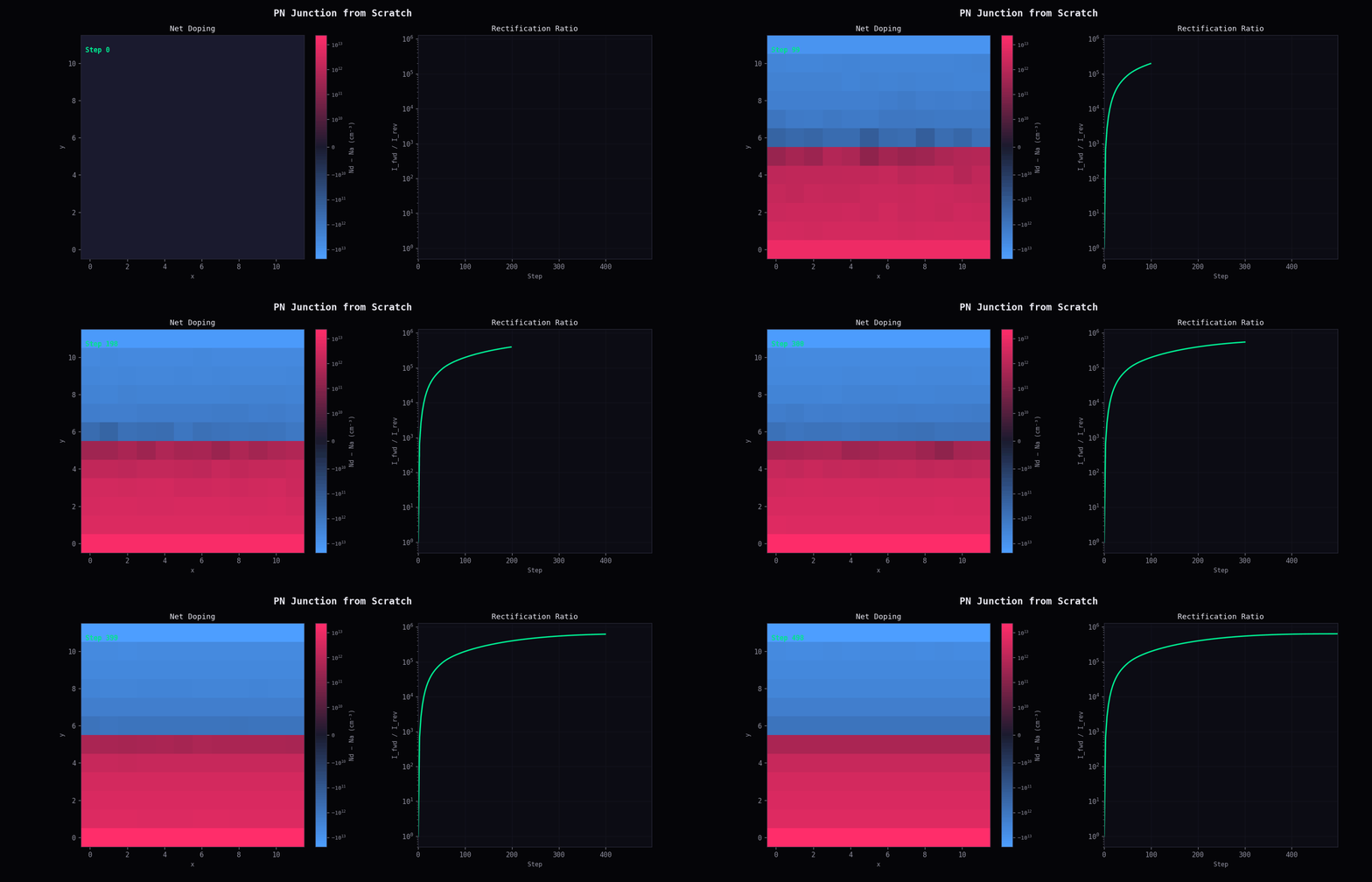
PN Junction from Scratch
Starting from uniform doping, the optimizer discovers spatial asymmetry and forms a PN junction by maximizing the rectification ratio.
12×12 grid · 500 steps · emergent spatial asymmetry from uniform doping

Tested against analytical solutions and TCAD.

Analytical
Shockley
Verified against the analytical Shockley diode equation across forward bias, on symmetric and asymmetric PN junctions.
TCAD comparison
DEVSIM
Cross-validated against the open-source DEVSIM TCAD reference on PN, asymmetric PN, and PIN devices.
Differentiable
AD
End-to-end automatic differentiation through the physics solver. Implicit differentiation at the converged Newton/Gummel fixed point for stable gradients.

Validated against five independent prior-art works (Hinze & Pinnau 2002, Romano ∂PV 2021, AD-NEGF, DDNet, ChargeTransport.jl). To our knowledge as of 2026-04-26, no commercial or open-source TCAD tool offers exact gradients through a 2D drift-diffusion solver.

Device physics. Differentiable.

MB

Mauricio Buendia

Mauricio Buendia is the founder of Driffusion. He is an MSc student in Neural Systems and Computation at the Institute of Neuroinformatics (UZH/ETH Zürich), with a thesis in Melika Payvand's lab on FeFET device modeling and a tape-out target on GlobalFoundries 22nm FD-SOI. Previously: BSc Electrical Engineering (Honors), TU Eindhoven, with prior industry experience at Prodrive Technologies. Driffusion is registered with ETH's Student Project House.

Institute of Neuroinformatics UZH / ETH Zürich TU Eindhoven ETH Student Project House
CM

Christian Metzner

Christian Metzner is cofounder of Driffusion. He is a PhD researcher at the Institute of Neuroinformatics (UZH/ETH Zürich) in Melika Payvand's lab. Recent work spans mixed-signal SNN optimizer design (with Indiveri and Grewe) and event-based hardware (ISCAS 2025). MSc Neural Systems and Computation, ETH/UZH.

Institute of Neuroinformatics UZH / ETH Zürich Mixed-signal SNN Payvand EIS Lab